Target’s tariff refund boost meets a widening retail value race
- Target (NYSE:TGT) reported $26.5 billion in second-quarter net sales, up 5.3%, while $994 million in tariff refunds lifted diluted EPS to $4.11.
- Large U.S. value retailers are still growing sales, but profitability varies sharply as companies balance pricing, digital fulfillment and operating costs.
- Tariffs, fuel and freight costs, consumer price sensitivity and aggressive value positioning remain key variables for the sector through 2026.

Target’s latest quarter puts the spotlight back on large-format and value-focused retailers.
The company posted higher traffic, stronger digital sales and a sharp earnings increase.
However, $994 million of tariff refunds accounted for $1.65 of Target’s $4.11 quarterly EPS.
That creates a useful comparison with four publicly traded peers competing for many of the same household spending dollars.
Target (NYSE:TGT)
Target reported second-quarter 2026 net sales of $26.54 billion, up 5.3% year over year.
Comparable sales increased 3.8%, supported by a 3.6% rise in traffic.
Digital comparable sales rose 8.7%, while same-day delivery grew more than 25%.
Operating income reached $2.56 billion, producing a 9.6% operating margin.
However, $994 million of tariff refunds contributed 3.7 percentage points to that margin and $1.65 to diluted EPS of $4.11.
Target now expects fiscal 2026 net sales growth around 5%, an operating margin around 6% and GAAP and adjusted EPS of 9.90–10.90.
The guidance includes the second-quarter tariff refund benefit but excludes potential future refunds.
Walmart (NASDAQ:WMT)
Walmart remains Target’s closest large-format competitor across groceries, general merchandise, digital fulfillment and advertising.
For its fiscal first quarter ended April 30, Walmart reported $177.8 billion in revenue, up 7.3%, while Walmart U.S. comparable sales excluding fuel increased 4.1%.
Global e-commerce sales rose 26%, and global advertising increased 37%.
Operating income increased 5% to about $7.5 billion, while diluted GAAP EPS rose to $0.67.
Walmart said higher fuel costs in distribution and fulfillment reduced operating income growth during the period.
For fiscal 2027, Walmart continues to project constant-currency net sales growth of 3.5%–4.5%, adjusted operating income growth of 6%–8%, and adjusted EPS of 2.75–2.85.
Costco Wholesale (NASDAQ:COST)
Costco competes differently through its paid membership model, but it overlaps with Target across groceries, household products, electronics, apparel and other discretionary categories.
Fiscal third-quarter net sales increased 11.6% to $69.15 billion, while total company comparable sales increased 9.8%.
Excluding gasoline-price and foreign-exchange effects, comparable sales rose 6.6%.
Quarterly net income reached $2.19 billion, or $4.93 per diluted share, compared with $1.90 billion and $4.28 per share a year earlier.
More recently, Costco reported $23.12 billion of July net sales, up 10.7%.
Digitally enabled comparable sales increased 17.7%, extending the retailer’s online growth alongside its warehouse network.
BJ’s Wholesale Club Holdings (NYSE:BJ)
BJ’s competes for household budgets through a membership warehouse model covering groceries, household essentials, apparel, electronics and fuel.
First-quarter fiscal 2026 net sales increased 9.9% to $5.53 billion, while total comparable club sales rose 6.3%.
Excluding gasoline, comparable sales increased 1.5%. Digitally enabled comparable sales grew 28%.
Operating income increased 2.1% to $207.9 million, although net income declined 4.7% to $142.7 million. Diluted EPS was $1.10, compared with $1.13 a year earlier.
BJ’s continues to forecast fiscal 2026 comparable club sales growth, excluding gasoline, of 2%–3% and adjusted EPS of $4.40–$4.60.
It also plans about $800 million of capital expenditure.
Dollar Tree (NASDAQ:DLTR)
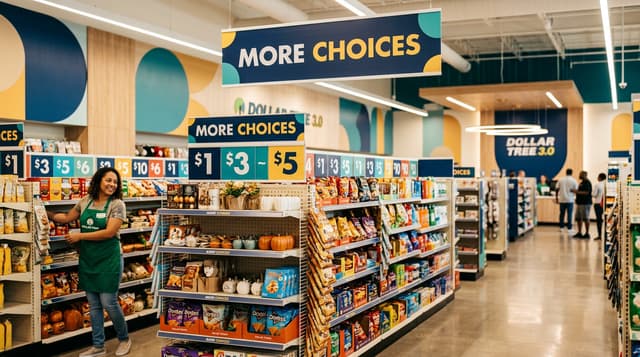
Dollar Tree represents the lower-price end of the same competition for value-conscious households, particularly across consumables and everyday general merchandise.
First-quarter fiscal 2026 net sales increased 7.2% to $5 billion, with comparable-store sales up 3.5%.
Average ticket increased 4.5%, while customer traffic declined 1%.
Operating income rose 23% to $473.3 million, and diluted EPS reached $1.76.
Dollar Tree said higher merchandise mark-on, lower freight and lower shrink supported gross margin, while tariff costs and markdowns partly offset those gains.
The company expects fiscal 2026 net sales of $20.5–$20.7 billion and adjusted diluted EPS of $6.70–$7.10.
In July, its board also replenished its share-repurchase authorization to $2.5 billion.
The bottom line
Target’s second-quarter figures show stronger traffic, digital growth and sales, but its headline earnings and margin benefited materially from tariff refunds.
Across the peer group, Walmart and Costco operate at far greater revenue scale, while BJ’s and Dollar Tree offer more concentrated value-oriented models.
Digital fulfillment is growing across all five businesses, but the margin impact of tariffs, fuel, freight, pricing and store investment differs by company.
For the sector, the operating contest remains centered on attracting price-sensitive consumers without giving up too much profitability.