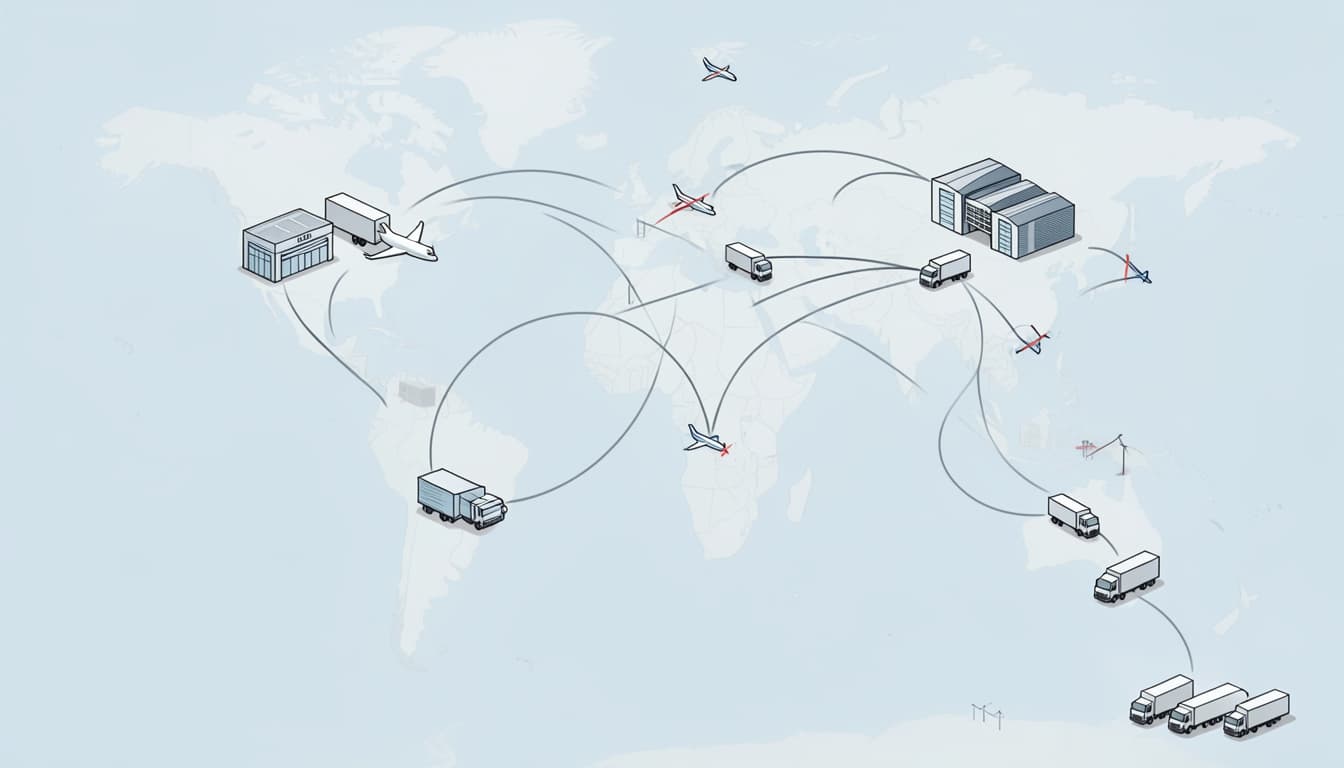
How global delivery networks are quietly sacrificing scale to protect operational margins
- FedEx reported $25 billion in fourth-quarter fiscal 2026 revenue while executing a spin-off of its freight division to consolidate core operations.
- The logistics provider exceeded cost-cutting targets by securing over $1 billion in structural savings and achieving an adjusted earnings per share of $6.60.
- Global transportation firms face mounting pressure to offset mixed profitability trends by heavily reducing capital spending and divesting secondary business units.

FedEx (NYSE:FDX)
FedEx reported fourth-quarter fiscal 2026 revenue of $25 billion.
The result was driven by higher volumes and targeted cost efficiency initiatives.
The company secured an adjusted earnings per share of $6.60, down from $6.88 last year.
Executives completed the spin-off of the FedEx Freight segment on June 1, 2026.
The separation process paid a $4.1 billion cash dividend to the parent company.
Management projects fiscal 2027 revenue growth of roughly 11%.
United Parcel Service (NYSE:UPS)
United Parcel Service operates as a direct competitor across domestic and international parcel delivery networks.
The company handles similar large-scale logistics operations and global supply chain services.
The firm currently targets consolidated annual revenue of approximately $89.7 billion.
Management routinely implements structural transformation programs to protect profitability.
Executives project a non-GAAP adjusted operating margin of approximately 9.6% for the current fiscal year.
XPO (NYSE:XPO)
XPO provides comprehensive less-than-truckload freight transportation services across North America.
The corporation competes for the commercial shipping volumes previously targeted by the divested FedEx Freight segment.
The business regularly generates annual revenues exceeding $8 billion.
Market pressures require the company to closely manage network capacity and terminal operations.
Executives focus capital allocations on expanding route efficiency to maintain pricing power.
J.B. Hunt Transport Services (NASDAQ:JBHT)
J.B. Hunt Transport Services manages extensive intermodal and dedicated freight transport operations.
The firm competes within the same domestic supply chain infrastructure as larger global logistics providers.
The business records annual revenues typically exceeding $12 billion.
Management focuses heavily on securing long-term corporate shipping contracts to stabilize cash flows.
The company must continually balance fleet expansion costs against shifting consumer
demand.
Expeditors International (NASDAQ:EXPD)
Expeditors International operates globally as a non-asset-based freight forwarding and logistics provider.
The enterprise coordinates complex supply chain operations without owning the physical transportation fleets.
The company generates annual revenues of approximately $11 billion.
The business model prioritizes high cash generation and minimal capital expenditure.
Market conditions force the firm to aggressively negotiate carrier rates to protect operating margins.
The bottom line
Global logistics providers are aggressively restructuring operations to defend profitability amid fluctuating shipping volumes.
Strong cost-cutting initiatives highlight a widespread shift away from rapid expansion toward disciplined capital management.
However, declining capital expenditures suggest transportation networks are preparing for sustained economic caution.
Valuations across the domestic delivery sector now depend on the successful execution of operational efficiencies and targeted asset spin-offs.