Home improvement demand tests the retail recovery race

- The Home Depot (NYSE:HD) reported fiscal Q2 2026 sales of $47.9 billion, up 5.7%, as comparable sales increased 1.7%.
- Lowe’s, Tractor Supply, Floor & Decor and Williams-Sonoma are facing similar consumer spending pressures across home projects, repairs and discretionary purchases.
- The sector outlook depends on housing activity, interest rates, consumer confidence and whether delayed renovation demand returns.
The Home Depot (NYSE:HD)
The Home Depot’s latest results show a cautious recovery across the home improvement market.
Fiscal Q2 2026 sales reached $47.9 billion, up 5.7% year over year.
Comparable sales increased 1.7%, while U.S. comparable sales rose 1.3%.
Adjusted diluted EPS reached $4.92, above analyst expectations of $4.73.
Net earnings totaled $4.8 billion, while GAAP operating income reached $6.8 billion with a 14.3% margin.
The company generated $89.6 billion in sales during the first six months of fiscal 2026 and produced $11.4 billion in operating cash flow.
Home Depot reaffirmed its fiscal 2026 outlook.
The company expects total sales growth of approximately 2.5% to 4.5%, comparable sales growth ranging from roughly flat to 2%, and diluted EPS growth of approximately flat to 4%.
The Home Depot operates more than 2,000 stores selling building materials, appliances, hardware, garden products and professional contractor supplies.
Lowe’s Companies (NYSE:LOW)
Lowe’s competes directly with Home Depot through home improvement products, appliances, tools and contractor services.
The company reported fiscal Q1 2026 sales of $20.9 billion, up 0.2% year over year.
Comparable sales declined 1.7%.
Comparable sales in the U.S. declined 1.6%, while operating income reached $2.5 billion. Adjusted operating margin was 12.1%.
Lowe’s reported adjusted diluted EPS of $2.92, compared with $3.06 in the prior-year quarter.
The company has focused on improving productivity, expanding professional customer relationships and strengthening its online shopping experience.
For fiscal 2026, Lowe’s expects total sales of $84 billion to $85 billion.
The company projects comparable sales growth between negative 1% and positive 1%.
The comparison with Home Depot highlights different consumer patterns across the same retail category.
Tractor Supply Company (NASDAQ:TSCO)
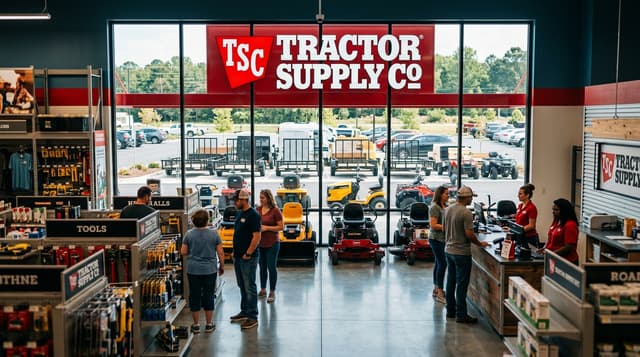
Tractor Supply operates rural lifestyle stores selling agricultural products, outdoor equipment, pet supplies and home-related goods.
The company reported second-quarter 2026 sales of $4.5 billion, up 3.6% year over year.
Comparable sales increased 1.1%, supported by growth in consumable and everyday-use categories.
Adjusted diluted EPS reached $3.71.
Operating income increased to $645 million, while operating margin expanded to 14.3%.
Tractor Supply has continued expanding its store network and digital capabilities.
The company reaffirmed its fiscal 2026 outlook, expecting sales growth of approximately 2% to 4% and comparable sales growth between flat and 2%.
While Tractor Supply is not a direct Home Depot competitor, both companies depend on consumers maintaining spending on property improvement and maintenance.
Floor & Decor Holdings (NYSE:FND)
Floor & Decor specializes in hard-surface flooring, including tile, wood, stone and related installation products.
The company reported second-quarter 2026 net sales of $1.2 billion, up 7.4% year over year.
Comparable store sales declined 0.9%, while new store openings contributed to overall revenue growth.
Adjusted EBITDA reached $147 million, and adjusted diluted EPS was $0.46.
Floor & Decor continues expanding its warehouse-format stores and targeting professional contractors.
The company expects fiscal 2026 net sales growth of approximately 8% to 10%, driven partly by new store openings.
Its results reflect a different part of the home improvement market, where larger renovation projects remain more sensitive to housing conditions and financing costs.
Williams-Sonoma (NYSE:WSM)
Williams-Sonoma competes in higher-end home furnishings, kitchen products and household accessories through brands including Pottery Barn and West Elm.
The company reported fiscal Q1 2026 net revenue of $1.99 billion, up 8.3% year over year.
Comparable brand revenue increased 6.5%, while adjusted operating margin reached 17.5%.
Williams-Sonoma reported adjusted diluted EPS of $4.36.
The company’s direct-to-consumer model gives it exposure to consumers upgrading homes through furniture, décor and kitchen purchases.
For fiscal 2026, Williams-Sonoma expects net revenue growth of approximately 3% to 5% and adjusted operating margin of 17% to 18%.
The company’s performance shows stronger demand in some premium home categories despite broader caution in discretionary spending.
The bottom line
Home improvement retailers are entering a period where growth depends less on broad consumer demand and more on the timing of postponed projects.
Home Depot delivered moderate sales growth, improved earnings and maintained its full-year outlook.
Lowe’s continues working through weaker comparable sales, while Tractor Supply benefits from more stable everyday spending categories.
Floor & Decor remains tied to renovation activity, while Williams-Sonoma shows stronger demand among higher-income consumers.
The common factor across these companies is housing. Interest rates, home prices and consumer confidence will continue influencing whether spending returns to larger improvement projects.