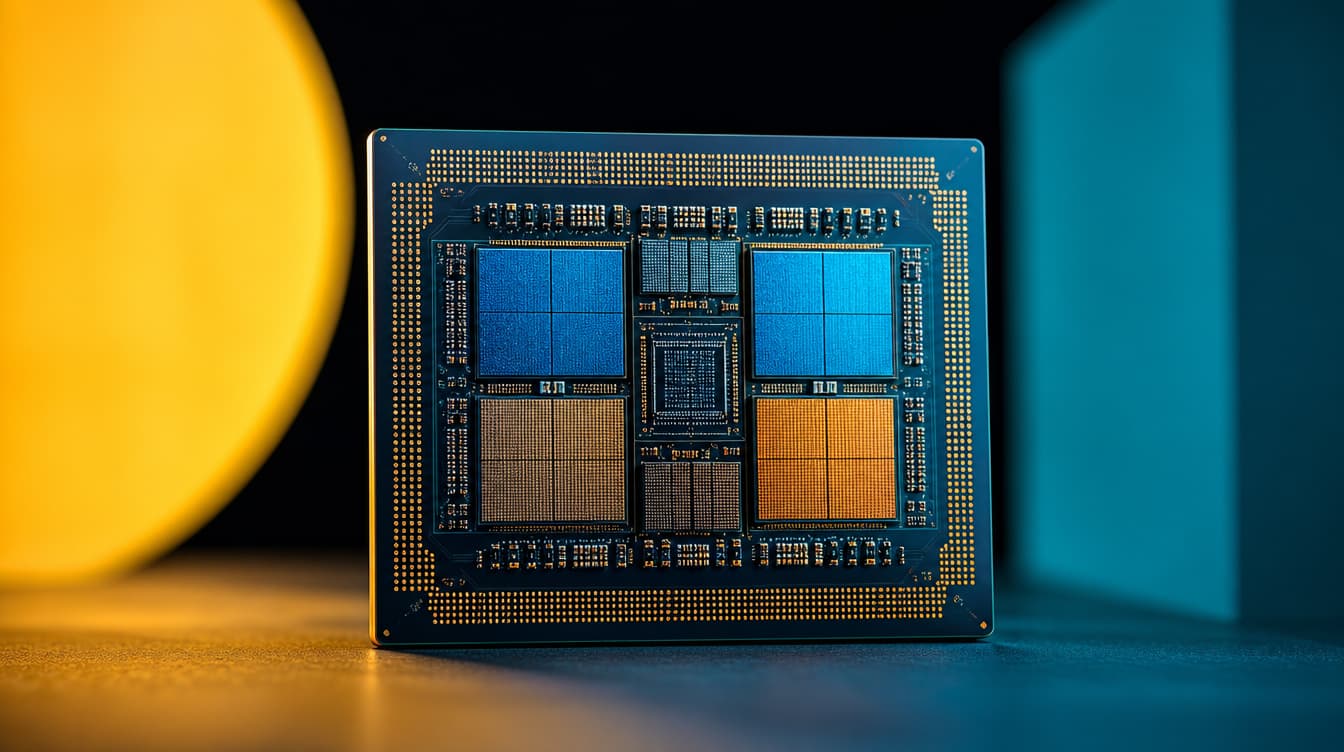
AMD secures tech lead as 6th gen EPYC "Venice" enters 2nm production

Advanced Micro Devices (NASDAQ:AMD) announced a major technological leap in its data center architecture, initiating the formal production ramp of its 6th Generation AMD EPYC enterprise processors, codenamed "Venice."
Developed in close collaboration with Taiwan Semiconductor Manufacturing Company (TSMC), the rollout establishes AMD as the first high-performance computing (HPC) merchant silicon provider to leverage advanced 2nm process technology.
Initial fabrication cycles for the 2nm "Venice" lineup are underway at TSMC’s primary advanced facilities in Taiwan.
To strengthen its geographically diverse manufacturing footprint and insulate supply line logistical risks, AMD also confirmed plans to expand production of the 2nm architecture at TSMC’s Fab 21 complex in Phoenix, Arizona, as those domestic lines phase into commercial readiness over the next several quarters.
The move to a 2nm architecture introduces gate-all-around (GAA) nanosheet transistors to the EPYC server roadmap.
This transition provides substantial architectural improvements in transistor density and voltage scaling compared to legacy FinFET nodes.
Corporate management emphasized that the compute acceleration comes at a critical structural turning point.
As enterprise data centers transition from basic foundational model training to highly complex agentic AI workloads—where autonomous software agents continuously execute multi-step logic chains, data lookups, and orchestration tasks—the host CPU is increasingly responsible for managing dense network traffic, vector storage, and system security.
Looking past the initial "Venice" enterprise deployment, AMD unveiled a parallel 2nm roadmap expansion codenamed "Verano."
Optimized specifically for total cost of ownership (TCO) efficiency and performance-per-dollar-per-watt metrics, the "Verano" follow-on silicon targets power-constrained enterprise environments.
A primary innovation inside the "Verano" platform includes the integration of low-power double data rate (LPDDR) memory solutions, leveraging ultra-compact JEDEC-compliant SOCAMM2 form factors.
By positioning energy-efficient LPDDR memory sub-systems horizontally closer to the CPU compute blocks, the design delivers the extreme memory bandwidth required to feed multi-turn agentic AI pipelines while reducing memory-subsystem power consumption.
The deployment of both 2nm CPU platforms relies on TSMC’s advanced backend packaging technologies, including System-on-Integrated-Chips (SoIC-X) 3D die stacking and Chip-on-Wafer-on-Substrate with Local Silicon Interconnect (CoWoS-L).
These structural interconnect platforms allow AMD to link multiple 2nm compute chiplets alongside specialized memory interfaces with micro-level latency, reinforcing the firm’s competitive data center footprint through the remainder of 2026.