

Australian inflation slows to 3.8% in June

- The Australian Bureau of Statistics (ABS) reported annual CPI inflation slowed to 3.8% in the year to June, down from 4.0% in May.
- Monthly CPI fell 0.1% in June, while trimmed mean inflation stayed at 3.6%, showing underlying price pressures remain above the Reserve Bank’s 2–3% target band.
- The ABS said housing, food and recreation costs were the main drivers of annual inflation, and confirmed CPI weights will next be updated for January 2027.
Annual CPI inflation in Australia slowed to 3.8% in the 12 months to June 2026, down from 4.0% in the year to May, according to the Australian Bureau of Statistics (ABS).
The ABS reported that trimmed mean inflation, which filters out large price moves, was 3.6% over the year to June, unchanged from May, indicating underlying inflation has not yet returned to the Reserve Bank of Australia’s 2–3% target range.
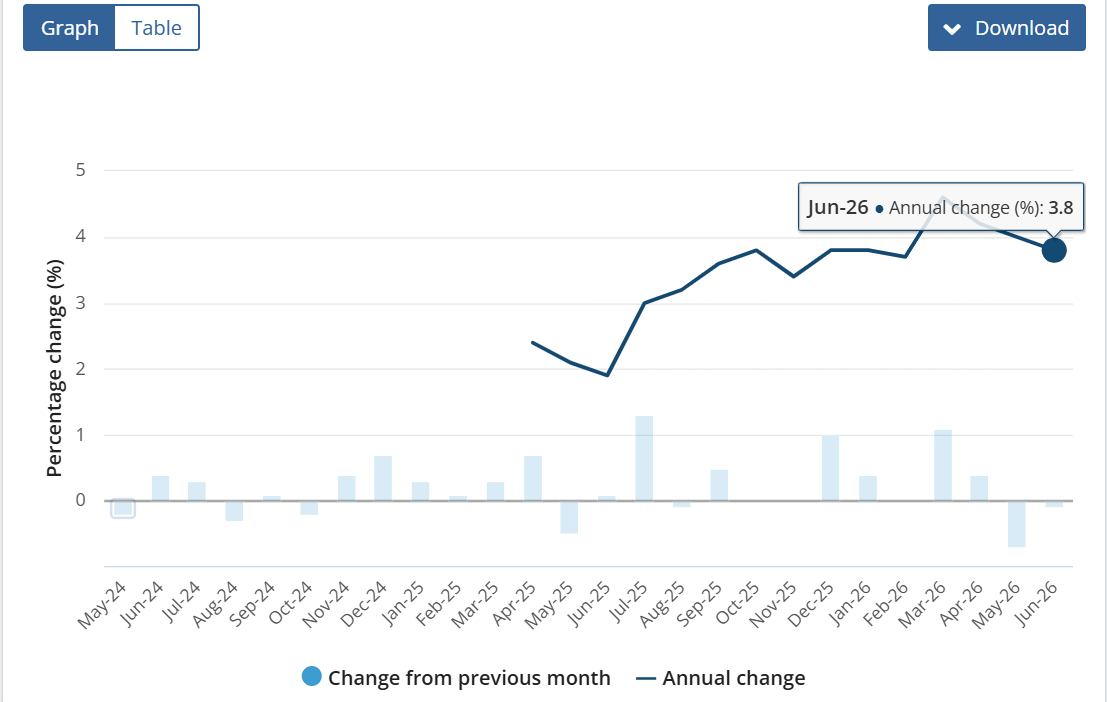
Source: Australian Bureau of Statistics (ABS), Consumer Price Index, Australia, June 2026.
“Housing, food and non‑alcoholic beverages, and recreation and culture were the largest contributors to annual inflation,” said the Australian Bureau of Statistics (ABS), with housing prices up 6.8% and food and recreation each rising 3.3% over the year.
The ABS data showed the CPI fell 0.1% in June on both original and seasonally adjusted bases, with transport prices down 2.7% for the month and tradable goods recording 1.5% annual inflation compared with 4.9% for non‑tradables such as housing and education.
The statistics agency stated that, from February 2027, monthly CPI releases will move to the fourth Wednesday of each month, and that the next update to CPI expenditure weights will occur for January 2027 after it decided a mid‑2026 update was not needed.
The ABS reported that annual inflation across the eight capital cities ranged from 3.2% in Melbourne to 4.2% in Adelaide and Hobart, with Sydney and Brisbane at 4.0%, Perth at 3.7%, Darwin at 3.9% and Canberra at 3.8%.
Analytical measures such as the weighted median (3.7%), CPI excluding volatile items (4.2%) and non‑discretionary inflation (4.0%) all remained above headline CPI, showing that many essential goods and services are still rising faster than overall prices.

_1440931_640x360_2506769475807-640x360.webp&w=3840&q=75)