
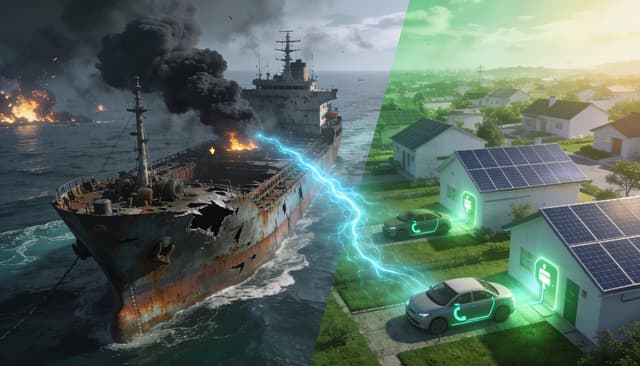

For decades, the global transition to renewable energy was a project of incrementalism — a slow-moving mosaic of carbon taxes, solar subsidies, and earnest international accords that often felt more aspirational than urgent.
Policy wonks argued over the nuances of the Inflation Reduction Act, while climate activists lamented the glacial pace of the "energy pivot."
Then came the spring of 2026.
With the closure of the Strait of Hormuz and the cascading escalation of the war on Iran, the theoretical "energy transition" was violently replaced by a "national security imperative."
What a thousand white papers could not achieve, the threat of a $180-a-barrel oil world did in a matter of weeks.
Future historians will likely record that the most effective climate policy in human history wasn't a piece of legislation passed in Washington or Brussels, but the geopolitical shock that finally broke the world’s psychological addiction to the internal combustion engine.
The death of the "second car"
The shift has been most visible on the showroom floors.
For years, electric vehicles (EVs) were marketed as a virtuous choice for the environmentally conscious or a high-performance toy for the wealthy.
But as the blockade of the Persian Gulf effectively severed the world’s primary oil artery, the EV was rebranded overnight as the ultimate tool of personal sovereignty.
In the first quarter of 2026, EV sales in Europe and North America surged by nearly 45% year-over-year.
This wasn't driven by a sudden surge in ecological altruism, but by the brutal math of the gas pump.
When filling a tank costs upwards of $150, the "range anxiety" that once plagued the industry was replaced by a far more visceral "price anxiety."
Consumers are no longer asking if an EV can handle a cross-country road trip once a year; they are asking if they can afford to drive to work on Monday.
The fortress home
The conflict has also fundamentally altered the domestic relationship with energy.
The "Fortress Home" — a residence equipped with rooftop solar and a battery storage system — has moved from a survivalist niche to a middle-class aspiration.
The volatility of the grid, exacerbated by cyber-tensions and the soaring cost of natural gas-fired electricity, has turned the home into a literal power plant.
In Australia and the American Sunbelt, waitlists for residential battery systems like the Tesla Powerwall have stretched into 2027.
We are witnessing the rapid decentralisation of the energy grid, not because it is "green," but because a decentralised grid is harder to hold hostage.
The war has proven that in an era of global instability, the most patriotic thing a citizen can do is produce their own electrons.
The policy paradox
There is a profound, if dark, irony in this transformation.
For years, hawks and doves alike argued over the "cost" of the green transition, often citing the trillions of dollars required to overhaul our infrastructure.
Yet, the economic cost of the current conflict — measured in lost GDP, military expenditures, and supply chain collapse — has already dwarfed those estimates.
The war on Iran has achieved what the Paris Agreement could not: it has aligned the interests of the Pentagon with those of the Sierra Club.
When a military general looks at a fleet of electric trucks, they no longer see an environmental statement; they see a logistics chain that doesn't depend on a vulnerable chokepoint six thousand miles away.
The end of the petroleum age
The 1973 oil embargo gave birth to the modern fuel-efficiency standard; the 2026 Hormuz crisis is giving birth to the post-petroleum world.
While the human and economic toll of the conflict is a tragedy of immense proportions, the silver lining is a world that is inadvertently, yet decisively, cooling.
The "Great Recalibration" is no longer a choice — it is an escape.
By forcing our hand, the crisis has ensured that even if the Strait of Hormuz reopens tomorrow, the world will never return to the same level of dependency.
The era of oil was built on the promise of reliability.
Now that that promise has been broken, the sun and the wind — for all their intermittency — have never looked more dependable.