
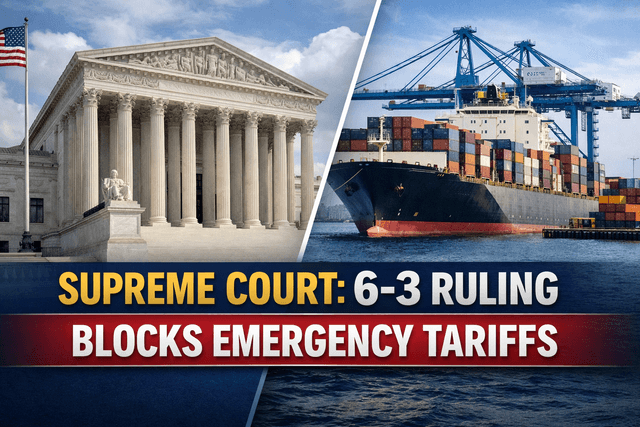

The U.S. Supreme Court delivered a historic blow to President Donald Trump’s economic agenda Friday, ruling 6-3 that the administration overstepped its constitutional authority by using a national emergency statute to impose sweeping global tariffs.
Writing for the majority, Chief Justice John Roberts clarified that while the Executive Branch has broad leeway to regulate commerce during crises, the power to levy taxes—including import duties—remains the sole province of Congress.
The decision immediately nullifies the "reciprocal" tariffs that have reshaped global trade over the last year, including a 34% duty on Chinese imports and 25% rates on goods from Canada and Mexico tied to fentanyl enforcement.
The ruling has triggered a frantic scramble among U.S. importers for what could be $170 billion in potential refunds.
Retail giants, including Costco, which sued the administration in December, and major brands like Revlon and Kawasaki are now positioned to reclaim billions in duties paid since the levies were enacted under the 1977 International Emergency Economic Powers Act (IEEPA).
While small business coalitions hailed the decision as a "tremendous victory," the White House reportedly characterized the ruling as a disgrace and signaled it is already preparing a "backup plan" to reimpose the taxes using alternative, sector-specific trade laws.
Industry analysts expect the sudden removal of these emergency duties to provide a significant tailwind for the U.S. economy, particularly in discretionary sectors like consumer electronics and apparel.
eMarketer revised its 2026 retail sales forecast upward by $13 billion to $7.78 trillion following the news, citing the relief for import-heavy categories.
However, legal experts warn that the reprieve may be short-lived; while IEEPA-based tariffs are gone, existing duties on steel and aluminum remain in effect, and the administration’s expected pivot to other legal authorities means the period of trade volatility is likely far from over.