
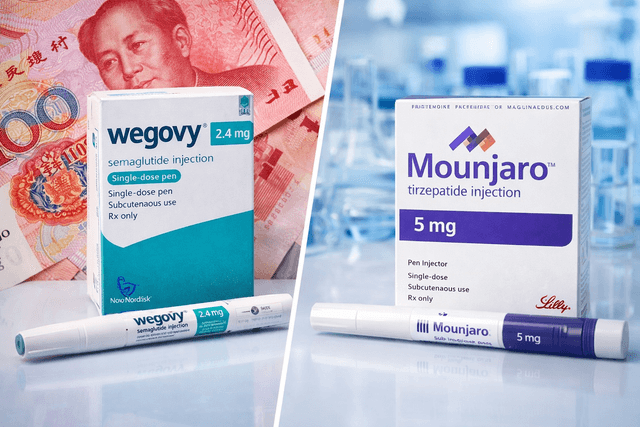
Novo Nordisk (NYSE:NVO) and Eli Lilly (NYSE:LLY) have begun an aggressive price-cutting campaign for their blockbuster obesity treatments in China, as the two pharmaceutical giants race to capture the world's largest patient population before local generic competition arrives.
According to local procurement data and media reports, list prices for Novo’s Wegovy have been slashed by as much as 48% in certain provinces, including Yunnan and Sichuan.
The highest dosages of the weekly injection are now listed at approximately 987 yuan ($141) and 1,284 yuan per month.
In a statement to Reuters, Novo Nordisk confirmed the adjustment, noting the move aims to "alleviate the treatment burden for patients" in the region.
The competition intensified as Eli Lilly’s Mounjaro saw even steeper price reductions.
Listings on China’s Meituan platform showed a 10mg Mounjaro injector pen priced at roughly 445 yuan ($63), a staggering 80% drop from its previous price of 2,180 yuan.
These new rates are expected to take effect officially across various hospital networks starting Jan. 1.
The pricing pivot comes at a critical juncture for both firms.
China’s obesity crisis is worsening, with estimates suggesting over 65% of its 1.4 billion citizens could be overweight or obese by 2030.
However, the Western drugmakers are no longer the only players in the field.
Local firms like Innovent Biologics are already competing for market share, while CSPC Pharmaceutical Group and Hangzhou Jiuyuan Genetic Biopharmaceutical are readying "biosimilar" versions of Novo’s semaglutide.
The urgency is underscored by the looming "patent cliff."
Novo Nordisk’s patent on semaglutide—the active ingredient in Wegovy—is set to expire in China in 2026.
By lowering prices now, Novo and Lilly are likely attempting to lock in brand loyalty and secure distribution channels before the market is flooded with lower-cost domestic alternatives.
This regional strategy mirrors recent moves in other emerging economies; Novo slashed Wegovy prices by 37% in India last month.
Both companies also reached agreements to lower U.S. costs in November as they shift their global focus toward higher-volume, cash-paying consumer markets.