
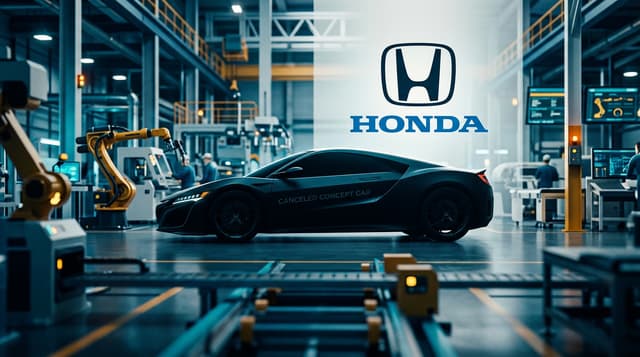

Honda Motor Company (NYSE:HMC) announced a drastic retrenchment of its electrification strategy on Friday, canceling the development and production of three core electric vehicles slated for the North American market.
The decision marks a watershed moment for the Japanese automaker, which anticipates the reversal will result in a staggering 2.5 trillion yen (approximately $15.7 billion) in total costs, including write-offs and asset impairments.
The canceled models—the Honda 0 SUV, the Honda 0 Saloon, and the Acura RSX—were intended to be the pillars of Honda’s next-generation EV lineup.
However, management concluded that proceeding with the launches in the current market environment would likely deepen long-term financial losses.
The company cited a "slowdown" in the U.S. EV market driven by the rollback of federal incentives and the easing of emissions regulations, alongside stiff competition from software-defined domestic manufacturers in China.
The financial fallout is expected to push Honda into its first annual net loss since it went public nearly 70 years ago.
Beyond the North American cancellations, the company is also bracing for impairment losses on its equity-method investments in China, where its competitive position has been eroded by local rivals.
U.S. tariff policies have further complicated the company's financial health by squeezing the margins of its traditionally profitable gasoline and hybrid segments.
In response to the crisis, Honda will pivot its resources toward hybrid models and aggressive fixed-cost reductions.
Future EV plans have been moved to a longer-term timeline, contingent on a recovery in market profitability.
Despite the historic loss and the multibillion-dollar write-down, Honda stated it does not currently plan to revise its dividend forecast for the fiscal year.