_1364938_640x360_2492955715715-640x360.webp&w=3840&q=75)

Markets Are Taking Volatility in Stride, Golub Says
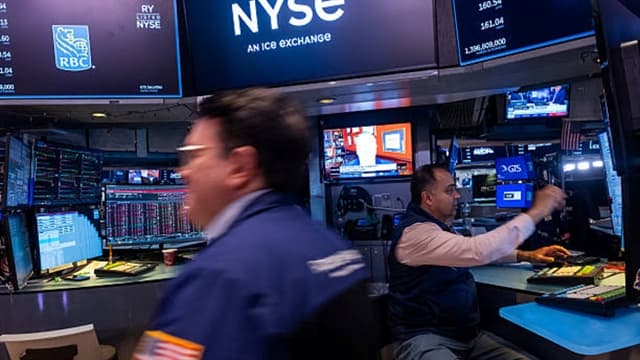
Seaport Chief Equity Strategist Jonathan Golub says global markets are taking volatility in stride. He says if markets were panicking, stocks would be lower. He speaks on "Bloomberg Surveillance."
Seaport Chief Equity Strategist Jonathan Golub says global markets are taking volatility in stride. He says if markets were panicking, stocks would be lower. He speaks on "Bloomberg Surveillance."
Schwab Asset Management CEO and CIO Omar Aguilar talks about how clients are positioning themselves as war risks linger. He says risk aversion has been "increasing dramatically" for the last few weeks. He speaks on "Bloomberg Surveillance."
FedEx does not expect the war in the Middle East to have a direct material effect on its business but warned of broader consequences to the overall economy. The parcel giant is raising its full-year profit forecast. Bloomberg Intelligence senior analyst Lee Klaskow joins Bloomberg Open Interest to talk about the results.
Michael Darda of Roth Capital says the bond markets have priced out any Fed easing that was expected a few months ago. He speaks on "Bloomberg Surveillance."
Bloomberg's Caroline Hyde discusses the recent indictments against the co-founder of Super Micro Computer, a Taiwan-based executive, and a contractor, accused of conspiring to illegally divert servers containing Nvidia chips to China.
In this video, a Supreme Court advocate tests generative AI on his own case, sparking debate over whether the technology can truly aid legal advocacy or merely sound convincing. Produced by Paul Detrick Senior Producer: Andrew Satter Executive Producer: Josh Block
This is the year AI has come for tax prep. Interviews with tax professionals suggest that artificial intelligence has finally improved to the point where it at least seems capable of navigating the US tax system as leading developers release more features for financial services. Bloomberg's Charlie Wells reports.
This is the year AI has come for tax prep. Interviews with tax professionals suggest that artificial intelligence has finally improved to the point where it at least seems capable of navigating the US tax system as leading developers release more features for financial services. Bloomberg's Charlie Wells reports.
World Trade Organization Chief Economist Robert Staiger discusses the impact of the ongoing conflict in the Middle East on trade. Speaking on Bloomberg Television, he says the WTO was already predicting a fall in merchandise trade from 4.6% in 2025 to 1.9% in 2026, but the effect of the war on energy prices could lower the growth further. "The growth rate would be 1.4% that we're predicting in 2026," Staiger says. He also talks about the impact of the Iran war on services trade.
Anna Edwards, Tom Mackenzie and Morwenna Coniam break down today's key themes for analysts and investors on "Bloomberg: The Opening Trade."
Ole Hansen, commodity strategy head at Saxo Bank, discusses the impact of the ongoing conflict in the Middle East on energy markets as oil heads for another weekly gain. Speaking on Bloomberg Television, Hansen says everything "points to a higher for longer" scenario. "It will take time to get that supply back, so higher for longer seems to be the risk right now," he adds.
Attacks on oil and gas infrastructure in the Arabian Gulf have escalated in the past two days. After a rebuke from President Trump, Israel says it will no longer target energy assets after its attack on an Iranian gas field sparked retaliatory strikes, cause oil and gas prices to surge. Crystol Energy Global Advisor, Christof Rühl, says the US is running out of methods to keep the oil price low if the Strait of Hormuz isn't reopened. He spokes to Joumanna Bercetche on Horizons Middle East and Africa.


_1364883_640x360_2492946499916-640x360.webp&w=3840&q=75)
_1363265_640x360_2492947523964-640x360.webp&w=3840&q=75)





_1364676_640x360_2492927555936-640x360.webp&w=3840&q=75)