Ceasefire to Bring Momentum Back to US Markets, Says Citi's Baldwin
Lucy Baldwin, global head of research at Citi, sees the US-Iran ceasefire deal letting markets return to the themes that were in focus before the start of the war.
Lucy Baldwin, global head of research at Citi, sees the US-Iran ceasefire deal letting markets return to the themes that were in focus before the start of the war.
Myles Bradshaw, head of global aggregate strategies at JPMorgan Asset Management, discusses the outlook for inflation, central bank policy and bond markets after the US and Iran agreed a two-week ceasefire. "As you're seeing the energy shock diminish, the risk of second round effects comes down," Bradshaw tells Bloomberg Television.
Anna Edwards, Guy Johnson and Paul Dobson break down today's key themes for analysts and investors on "Bloomberg: The Opening Trade."
Bloomberg's Benedikt Kammel discusses the impact of the two-week ceasefire between the US and Iran on airlines and the implications for jet fuel prices and air fares.
Henry Allen, Deutsche Bank macro strategist, discusses the implications of the two-week ceasefire between the US and Iran on markets and oil prices. "We're not seeing the data downgrades we saw back in 2022 when Russia invaded Ukraine and oil was up $120 a barrel," Allen tells Bloomberg Television.
The US and Iran have agreed to a two-week ceasefire, in a move that could pause the conflict after six weeks of fighting. But while the deal is expected to halt attacks for now, key issues remain unresolved -- from the opening up of the Strait of Hormuz to broader tensions over Iran's nuclear and missile programs. Mark MacCarley, Retired US Army Major General and Managing Attorney at MacCarley & Rosen spoke to Bloomberg's Horizons Middle East and Africa anchor Joumanna Bercetche on the next steps for the two countries.
Sophie Huynh, portfolio manager and strategist at BNP Paribas Asset Management, reacts to the two-week US-Iran ceasefire announcement and whether the relief rally in markets can be sustained. "How long it's going to take for oil to reach those countries as the Strait of Hormuz potentially opens is, I think, a key question," Huynh tells Bloomberg Television.

The era of "AI augmentation" — that polite corporate fiction where software was merely a "co-pilot" designed to help humans work faster — has ended.
In its place, 2026 has ushered in a period of cold, clinical replacement.
For decades, the global transition to renewable energy was a project of incrementalism — a slow-moving mosaic of carbon taxes, solar subsidies, and earnest international accords that often felt more aspirational than urgent.
Policy wonks argued over the nuances of the Inflation Reduction Act, while climate activists lamented the glacial pace of the "energy pivot."
Israel's Prime Minister Benjamin Netanyahu says his country supports Iran deal, but ceasefire doesn't include Lebanon. Bloomberg's Dan Williams reports.
For the better part of a decade, the gilded youth of the financial world — the "crypto-native" generation — dismissed gold as a "boomer rock."
To them, the heavy, yellow metal was an analog relic, a petrous souvenir of an era before the lightning-fast efficiency of the blockchain.
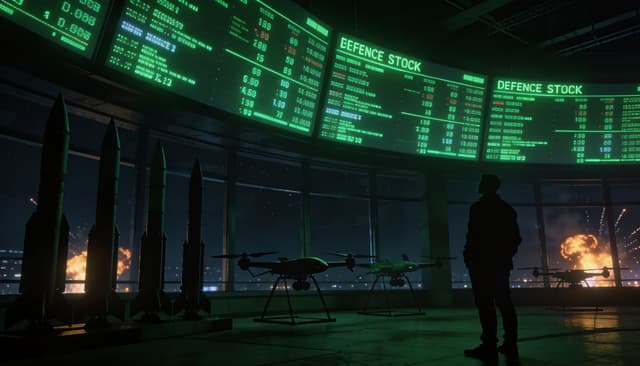
For years, the global defence industry existed in a sort of polite exile.
In the era of ESG mandates and the "peace dividend," shares in weapons manufacturers were often treated as the "tobacco stocks" of the new millennium — profitable, perhaps, but unseemly.
_1376025_640x360_2495524931723-640x360.webp&w=3840&q=75)


_1375928_640x360_2495523395561-640x360.webp&w=3840&q=75)



_1375924_640x360_2495519299821-640x360.webp&w=3840&q=75)