
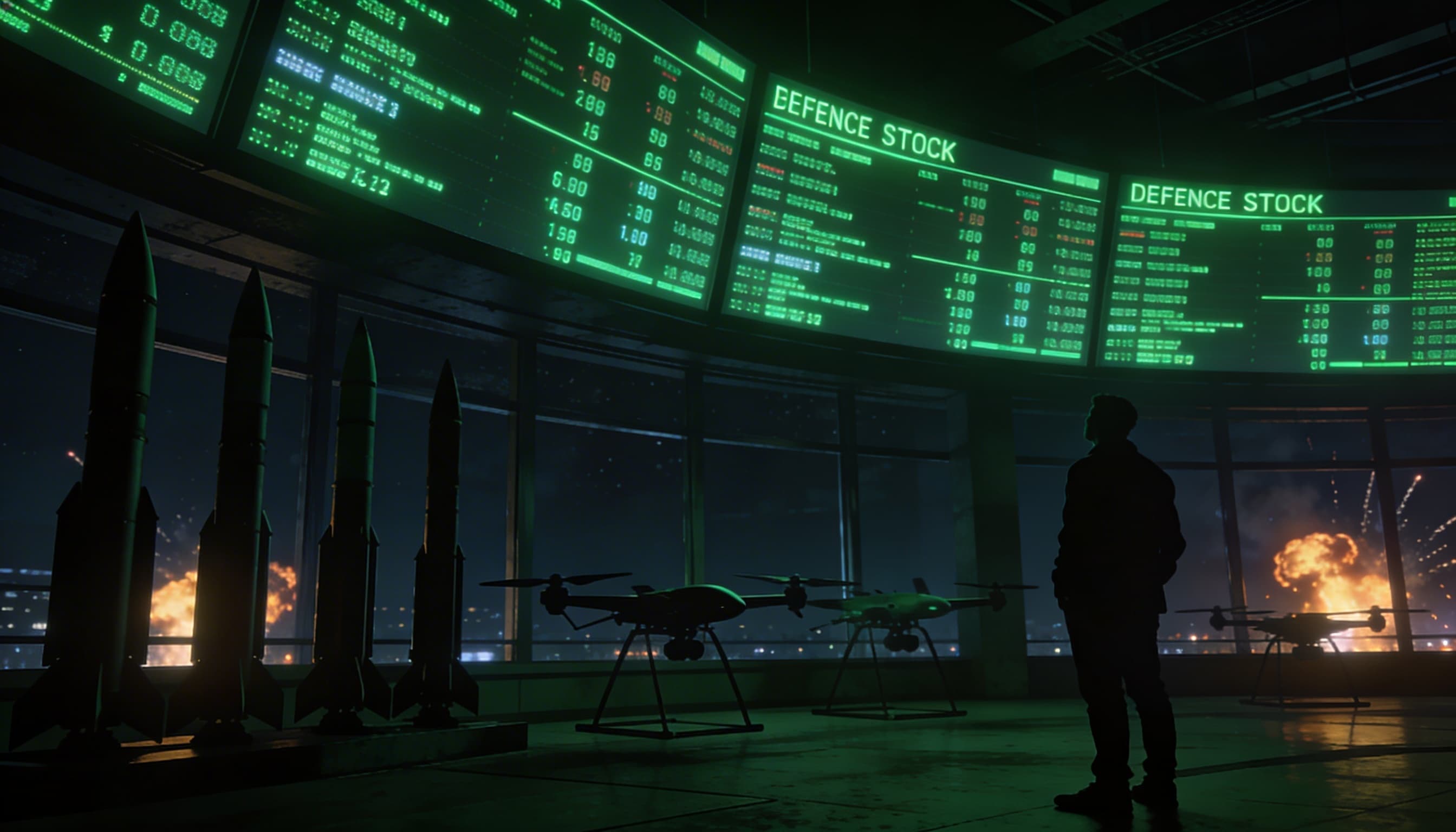
The bull market in bloodshed

Grafa
The bull market in bloodshed
Brie Carter
Written by Brie Carter
Share

For years, the global defence industry existed in a sort of polite exile. 

In the era of ESG mandates and the "peace dividend," shares in weapons manufacturers were often treated as the "tobacco stocks" of the new millennium — profitable, perhaps, but unseemly. 

But as the smoke of conventional warfare drifted across Europe and the Pacific in early 2024, the moral calculations of the global markets underwent a swift and clinical revision.

Today, on the exchanges of New York, London, and Sydney, the business of war has been rebranded as the business of survival. 

Since the outbreak of the current conflict, defense stocks have not just outperformed the market; they have decoupled from reality. 

What we are witnessing is the "Fortress Finance" era — a period where the most reliable path to wealth is the fabrication of machines designed to destroy it.

A global rearmament

The rally has been a synchronised phenomenon across the Western alliance. 

On Wall Street, the titans of the American military-industrial complex — Lockheed Martin (NYSE:LMT), RTX (NYSE:RTX), and Northrop Grumman (NYSE:NOC) — have seen their valuations swell as the Pentagon transitions from a "just-in-time" supply chain to a "just-in-case" posture of permanent mobilisation.

In London, BAE Systems (LON:BA) has shed its image as a sluggish industrial giant to become the crown jewel of the FTSE 100, its order books overflowing with the frantic requirements of a re-arming Continent. 

Even on the Australian Securities Exchange (ASX), a new tier of "asymmetric" defense firms like Droneshield (ASX:DRO) have surged. 

In the eyes of the market, the AUKUS pact is less a diplomatic treaty than a multi-decade revenue guarantee.

The moral hazard of the ledger

There is something inherently jarring about a brokerage report that describes a surge in drone warfare as a "meaningful catalyst for growth." 

The stock market is an amoral mirror, reflecting our collective priorities back at us with cold efficiency. 

By rewarding the preparation for conflict so handsomely, the financial system has created a perverse set of incentives.

When the "peace dividend" is a drag on a portfolio, and a diplomatic breakthrough is viewed by analysts as a "downside risk," we have entered a dangerous territory. 

We are now living in an economy where the cost of a ceasefire is measured in a dip in the S&P 500.

The new normal

This is no longer a temporary spike in the wake of a crisis. 

The rise of defence stocks across the ASX, the US, and the UK represents a structural pivot in the global economy. 

The "merchants of death" have been rehabilitated as the "guardians of the rules-based order," and the market has responded by making them some of the most powerful — and wealthiest — individuals on the planet.

As we look toward the remainder of 2026, the message from the markets is clear: the world is getting more dangerous, and for those holding the right tickers, danger has never looked so lucrative.

Conecte-se conosco

A Grafa não é um consultor financeiro. Você deve buscar aconselhamento independente, jurídico, financeiro, tributário ou de outra natureza que se relacione às suas circunstâncias únicas.

A Grafa não se responsabiliza por qualquer perda causada, seja por negligência ou de outra forma, decorrente do uso ou da confiança nas informações fornecidas direta ou indiretamente pelo uso desta plataforma.