
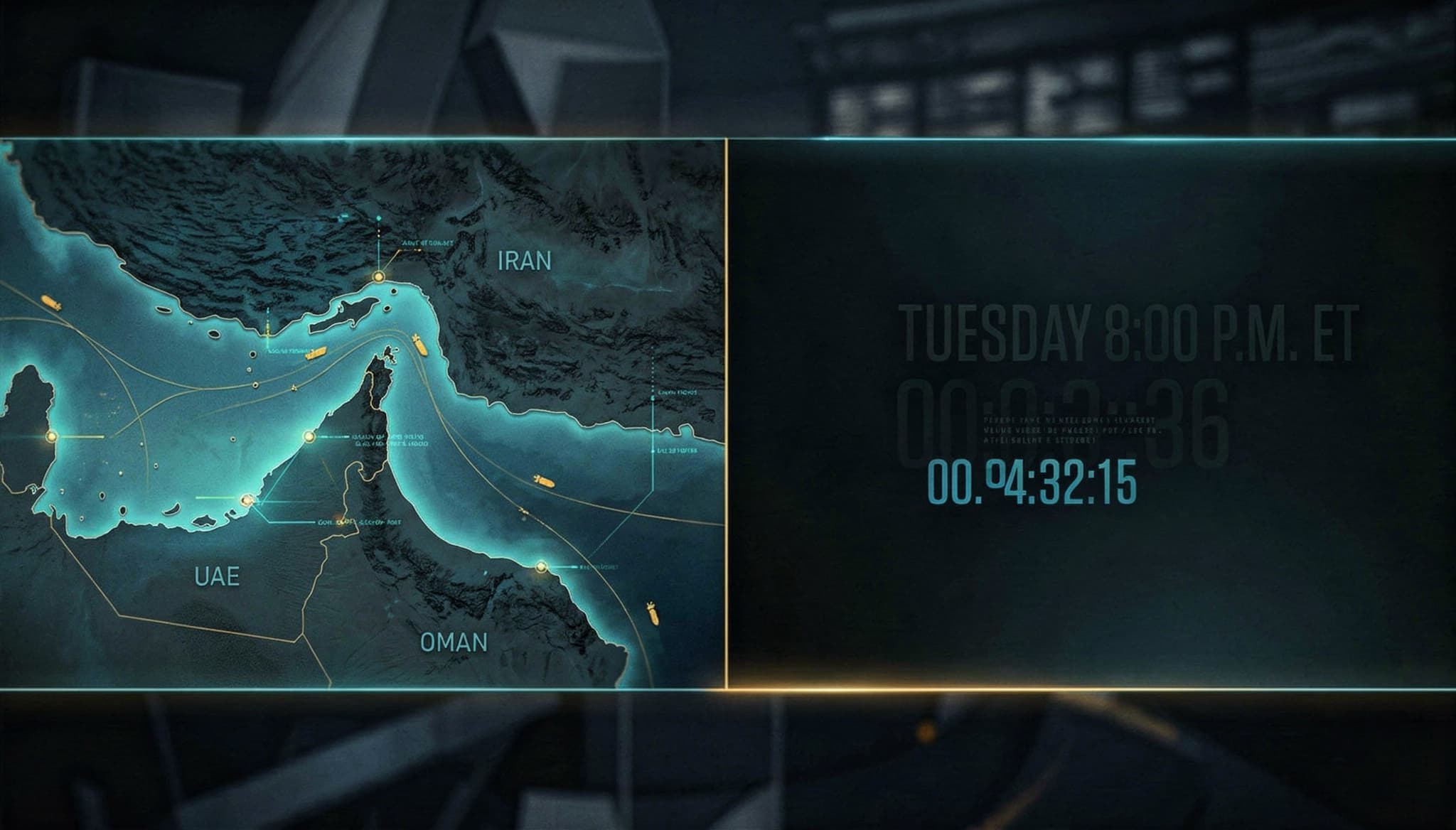
Markets brace for Tuesday deadline as Trump threatens Iranian power grid

Global financial markets entered a state of high-alert Monday morning as President Donald Trump issued a final, televised ultimatum to Tehran, threatening the total destruction of Iran’s industrial infrastructure if the Strait of Hormuz is not reopened by Tuesday evening.
The geopolitical standoff, which has seen Iran deploy drones and missiles against Gulf neighbors and Israel, reached a fever pitch following a Wall Street Journal interview on Sunday.
In the discussion, Trump extended a previous 10-day deadline to Tuesday at 8:00 P.M. Eastern Time.
"If they want to keep it [the Strait] closed, they're going to lose every power plant and every other plant they have in the whole country," Trump stated.
The Strait of Hormuz is the world's most critical oil chokepoint, facilitating the transit of roughly 20% of global petroleum liquids.
Oil futures remained volatile and mixed in early Monday trade.
Brent crude rose 0.5% to $109.57 a barrel, while U.S. West Texas Intermediate (WTI) dipped slightly to $110.88.
Analysts at MUFG warned that the lack of a "credible de-escalation path" keeps the risk premium firmly embedded in energy prices, with further upside likely if the Tuesday deadline passes without a resolution.
Surprisingly, spot gold fell 0.4% to $4,657.86 per troy ounce.
Market strategists noted that gold is losing its traditional "safe-haven" luster to the U.S. dollar, which investors currently favor for its superior liquidity and convertibility during active conflict.
Meanwhile, the threat of sustained $100+ oil has sent shockwaves through the fixed-income markets, as investors bet that energy-driven inflation will force central banks to keep interest rates "higher for longer."
Despite the tension, Asian equities managed gains in holiday-thinned trading.
The Nikkei 225 closed up 0.5% at 53,413.68, while South Korea’s Kospi jumped 1.4%.
Major markets in China, Hong Kong, and Australia remained closed for the Monday holiday, likely muting the immediate global sell-off.
All eyes now turn to the Tuesday 8:00 P.M. ET window, which marks the potential start of a significant kinetic escalation in the region.