
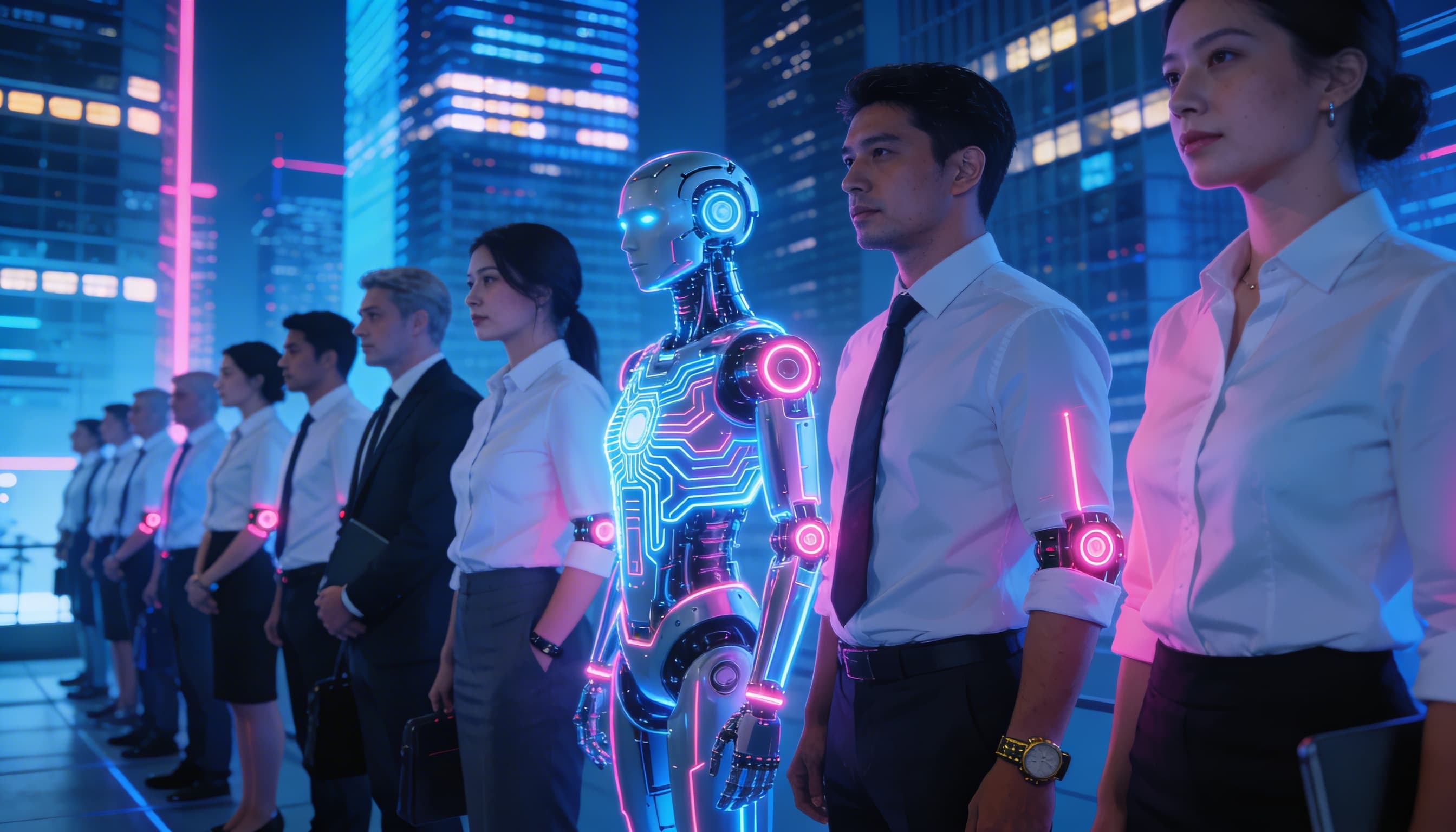
The great white-collar contraction

The era of "AI augmentation" — that polite corporate fiction where software was merely a "co-pilot" designed to help humans work faster — has ended.
In its place, 2026 has ushered in a period of cold, clinical replacement.
For two years, CEOs promised that artificial intelligence would liberate workers from drudgery.
Instead, as evidenced by a wave of structural layoffs across the S&P 500, it is liberating companies from their payrolls.
The "Silicon Scythe" is no longer a forecast; it is a line item in the quarterly earnings of the world’s most powerful firms.
The most aggressive architect of this new reality is Klarna (NYSE:KLAR).
The Swedish fintech giant recently stunned labor analysts by announcing that its AI assistant is now performing the equivalent work of 700 full-time customer service agents.
CEO Sebastian Siemiatkowski didn't frame this as a partnership between man and machine; he framed it as a replacement, noting that the AI does the work with higher accuracy and in a fraction of the time.
For Klarna, the result is a projected $40 million increase in annual profit, achieved specifically by allowing its human headcount to wither.
This isn't an isolated European experiment; it is the new playbook for American tech.
At Block (NYSE:XYZ), the parent company of Square and Cash App, Jack Dorsey has implemented a hard cap on headcount at 12,000 employees.
The move is a direct bet on AI’s ability to handle engineering and design tasks that previously necessitated thousands of additional hires.
Dorsey’s mandate is a signal to Silicon Valley: the days of "empire building" through massive hiring are over. Efficiency is the new status symbol, and human labor is increasingly viewed as a legacy cost.
The "physical" economy is proving just as vulnerable to this algorithmic thinning.
UPS recently eliminated 12,000 management positions, a move explicitly tied to the integration of AI-driven logistics and routing software.
The message from the Atlanta headquarters was clear: technology has made these human layers redundant.
Similarly, Amazon (NASDAQ:AMZN) has moved beyond its well-documented automation of warehouse floors to a more surgical pruning of its corporate ranks.
By leveraging generative AI to automate code generation and project management, the company has shed thousands of roles in its "Web Services" and "Devices" units, proving that even the most highly skilled software engineers are not immune to the logic of the machine.
Wall Street has responded to this hollowing out of the workforce with exuberant approval.
Investors are no longer rewarding companies for their "talent density"; they are rewarding them for their "compute efficiency."
This has created a jarring disconnect where a company’s stock price often surges the moment a mass layoff is announced, provided that layoff is paired with a promise of AI integration.
We are witnessing the rise of the "Lean Giant"— multi-billion-dollar entities like Salesforce (NYSE:CRM) or IBM (NYSE:IBM) that are aggressively reducing support and back-office roles while their valuations continue to touch record highs.
This structural shift is effectively destroying the entry-level career ladder.
When the junior analyst roles at a bank or the customer support positions at a tech firm are automated, the industry loses its primary training ground.
We are moving toward a bifurcated economy: a small, highly compensated elite who manage the algorithms, and a vast, displaced professional class whose degrees in finance, law, or coding no longer provide a shield against obsolescence.
The layoffs of 2026 are not a response to a slowing economy; they are the result of a permanent technological pivot.
By decoupling productivity from employment, the modern corporation has achieved its ultimate goal of margin expansion, but at the cost of the social contract.
The efficiency of the machine is here, and as companies like Klarna and Square are proving, the human worker is no longer an essential part of the equation.
We have spent decades worrying about the "robot apocalypse" in factories, only to find that the real axe was a line of code in the corner office.