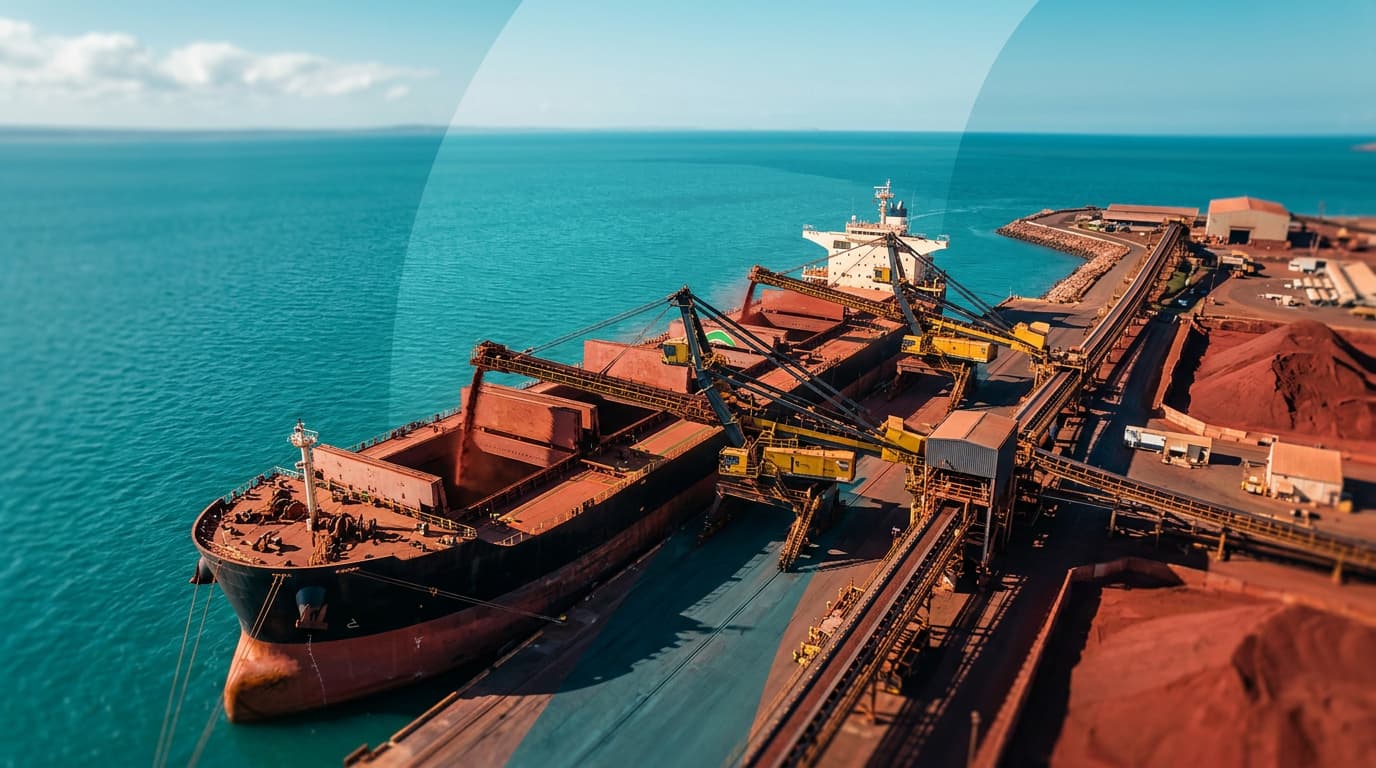
Rio Tinto resumes Pilbara Port operations following Cyclone Narelle disruption

Rio Tinto Group (NYSE:RIO), the world’s leading iron ore producer, announced Monday that it has resumed ship loading at the majority of its Pilbara port terminals following a temporary suspension caused by Tropical Cyclone Narelle.
Despite the disruption, which followed a previous weather event in February, the miner reaffirmed its full-year shipment guidance, citing a clear "pathway" to recovering a significant portion of the lost tonnage.
Port operations at the company’s four Pilbara terminals—East Intercourse Island, Parker Point, Cape Lambert A, and Cape Lambert B—were suspended on March 24 as the cyclone intensified off the coast of Western Australia.
Rio Tinto confirmed that loading operations at East Intercourse Island, Parker Point, and Cape Lambert B successfully recommenced on March 28.
The fourth terminal, Cape Lambert A, sustained damage during the storm and is currently undergoing repairs, with shipping expected to resume in the coming days.
The passage of Cyclone Narelle, combined with Tropical Cyclone Mitchell in February, has impacted Rio Tinto’s year-to-date iron ore shipments by approximately 8 million metric tons.
However, the company stated it has identified operational strategies to recover roughly half of those losses over the remainder of the year.
Consequently, Rio Tinto’s 2026 guidance for Pilbara iron ore shipments remains unchanged at 323 million to 338 million tons.
The cyclone’s reach extended beyond the Pilbara, impacting diverse mining operations across northern Australia.
Earlier this month, the system brought heavy rainfall and power outages to the northeast coast, forcing Rio Tinto to temporarily shutter two bauxite mines in Queensland.
Furthermore, South32—in partnership with Anglo American—suspended operations at its Gemco manganese mine on Groote Eylandt as a safety precaution while the storm tracked through the region.
While the immediate logistical backlog is expected to take several weeks to clear, the safety of all personnel was maintained throughout the event.
Rio Tinto continues to monitor weather patterns closely as the Australian cyclone season enters its final month, with a focus on maintaining the integrity of its rail and port infrastructure to meet its ambitious 2026 delivery targets.