

SpaceX raises US$75b in record‑breaking IPO
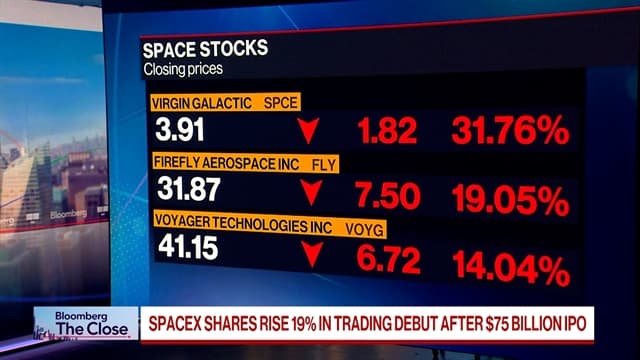
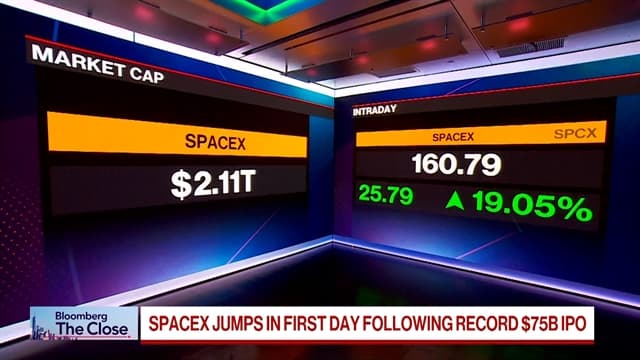
SpaceX raised US$75 billion by selling about 555 million shares at US$135 each, valuing the company near US$1.8 trillion and making Elon Musk a paper trillionaire.
SpaceX raised US$75 billion by selling about 555 million shares at US$135 each, valuing the company near US$1.8 trillion and making Elon Musk a paper trillionaire.

On the third day of trading, SpaceX's market capitalization surged to approximately $2.7 trillion, positioning the company to surpass Amazon in market value. Joining the discussion, Aswath Damodaran, Professor of Finance at NYU Stern School of Business, provided his valuation perspective. He explained that his recent analysis estimated SpaceX's enterprise value at around $1.2 trillion and equity value near $1.3 trillion, roughly half of the current market cap. He speaks with Romaine Bostick & Katie Greifeld on "The Close."
"Data centers in space" may sound like science fiction, but as the SpaceX IPO augurs a space boom, tech giants and startups are betting orbital artificial intelligence is the next frontier.
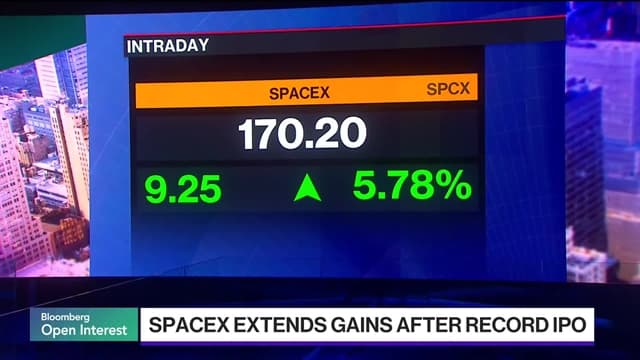
SpaceX extends its post-IPO rally, while airline stocks take off as the US-Iran strike an interim agreement to reopen the Strait of Hormuz. Jefferies analyst Sheila Kahyaoglu joins "Bloomberg Open Interest" to break down the latest moves in aerospace and airlines.
Heather Pringle, CEO of the Space Foundation, discussed the impact of SpaceX's historic $75 Billion IPO on the broader space industry and investment landscape. She highlighted that SpaceX's public listing marks a significant milestone for a maturing space sector, demonstrating viable pathways to profitability through communications, launch services, and navigation technologies. she speaks with Romaine Bostick & Katie Greifeld on "The Close."
Lise Buyer, Founder at Class V Group and one of the architects of Google's IPO, provided insights on SpaceX's recent record-breaking $75 billion IPO. She highlighted the unusual aspects of the offering, including its fixed pricing rather than a price range, and the staggered lockup release structure. She speaks to Romaine Bostick & Katie Greifeld on "The Close."
Tom Mueller, Founder and CEO of Impulse Space and first employee at SpaceX, discussed SpaceX's evolution from a risky startup in 2002 to a $2 trillion public company. He described early skepticism, repeated test failures, and key milestones such as reaching orbit, servicing the ISS, landing reusable rockets, and enabling global internet. He speaks with Romaine Bostick & Katie Greifeld on "The Close."
Jay Ritter, director of The IPO Initiative and Emeritus Professor at the University of Florida, discussed the unprecedented $75 billion SpaceX IPO, highlighting its fixed $135 offer price set before the roadshow a highly unusual approach. This pricing strategy resulted in a first-day stock price jump that left approximately $20 billion in first-day profits on the table, more than double the previous U.S. IPO record held by Alibaba. He speaks with Romaine Bostick & Katie Greifeld on "The Close."
New York City Comptroller Mark Levine discussed the fast-tracking of SpaceX's inclusion into major indexes such as MSCI Global Standard and FTSE Russell, highlighting concerns about the abandonment of traditional criteria like seasoning periods and earnings track records. Levine emphasized the unprecedented governance structure of SpaceX, where a single individual holds dominant control with limited shareholder rights and no independent board oversight. He speaks with Romaine Bostick & Katie Greifeld on "The Close."
As Elon Musk is poised to be crowned the world's first trillionaire, Bloomberg's Max Chafkin and Ed Ludlow break down Musk's growing control of SpaceX, the possibility of a Tesla, SpaceX merger, and why investors will follow Musk to the Moon, despite mounting questions about governance and execution.
_1422733_640x360_2503830595823-640x360.webp&w=3840&q=75)


_1420669_640x360_2503492675523-640x360.webp&w=3840&q=75)
_1420654_640x360_2503481923555-640x360.webp&w=3840&q=75)
_1420471_640x360_2503454275938-640x360.webp&w=3840&q=75)