
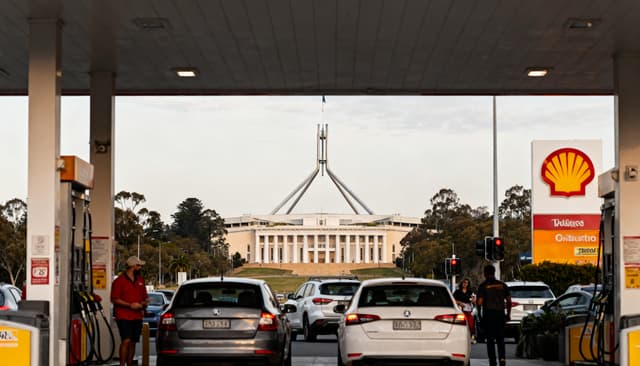

The Albanese government will temporarily relax fuel stockpile and quality rules as conflict in the Middle East and panic buying squeeze supplies in rural and regional Australia.
Energy Minister Chris Bowen said minimum stockholding obligations introduced in 2023 will be lowered, with the diesel requirement cut from about 2.7 billion litres to 2.2 billion litres and petrol from 1 billion litres to 700 million litres to give companies more flexibility moving fuel to areas most at risk of running dry.
“After careful consideration, we are adjusting the minimum stock obligation for diesel and fuel to enable companies to better handle and better manage their supply chain more flexibly as they try and get more fuel to regional Australia,” said Albanese government Energy Minister Chris Bowen.
Bowen stressed that emergency reserves “will not be released immediately” and that the government’s focus is on easing bottlenecks, including by temporarily allowing higher‑sulphur fuel to be blended into domestic supply for the next 60 days, unlocking an extra 100 million litres a month that Ampol has pledged to prioritise for regional and rural customers and the spot market.
Officials are trying to calm fears of outright shortages after a surge in demand saw fuel purchases roughly double in recent days, even as Bowen insisted “our fuel supplies continue to arrive, our fuel stocks continue to be strong” and Health Minister Mark Butler argued Australia now holds more fuel than at any time in 15 years thanks to Labor’s minimum stockholding laws, which the opposition opposed.
The policy shift comes as Iran’s effective choking of traffic through the Strait of Hormuz, a route that normally carries about one‑fifth of the world’s seaborne oil, has driven crude back above $US100 a barrel and pushed Australian pump prices sharply higher, with the national average petrol price jumping 17 cents in a week to 198 cents a litre and diesel in South Australia hitting a record $2.46.
The International Energy Agency has agreed to release an unprecedented 400 million barrels from global reserves to stabilise flows, while at home Australia’s stocks sit at about 30 days of total fuel—well below the IEA’s 90‑day benchmark—with 36 days of petrol, 29 days of jet fuel and 32 days of diesel, prompting Prime Minister Anthony Albanese to warn that a prolonged conflict and ongoing disruption in the Strait of Hormuz would mean sustained pressure on prices, production, supply chains and inflation.