
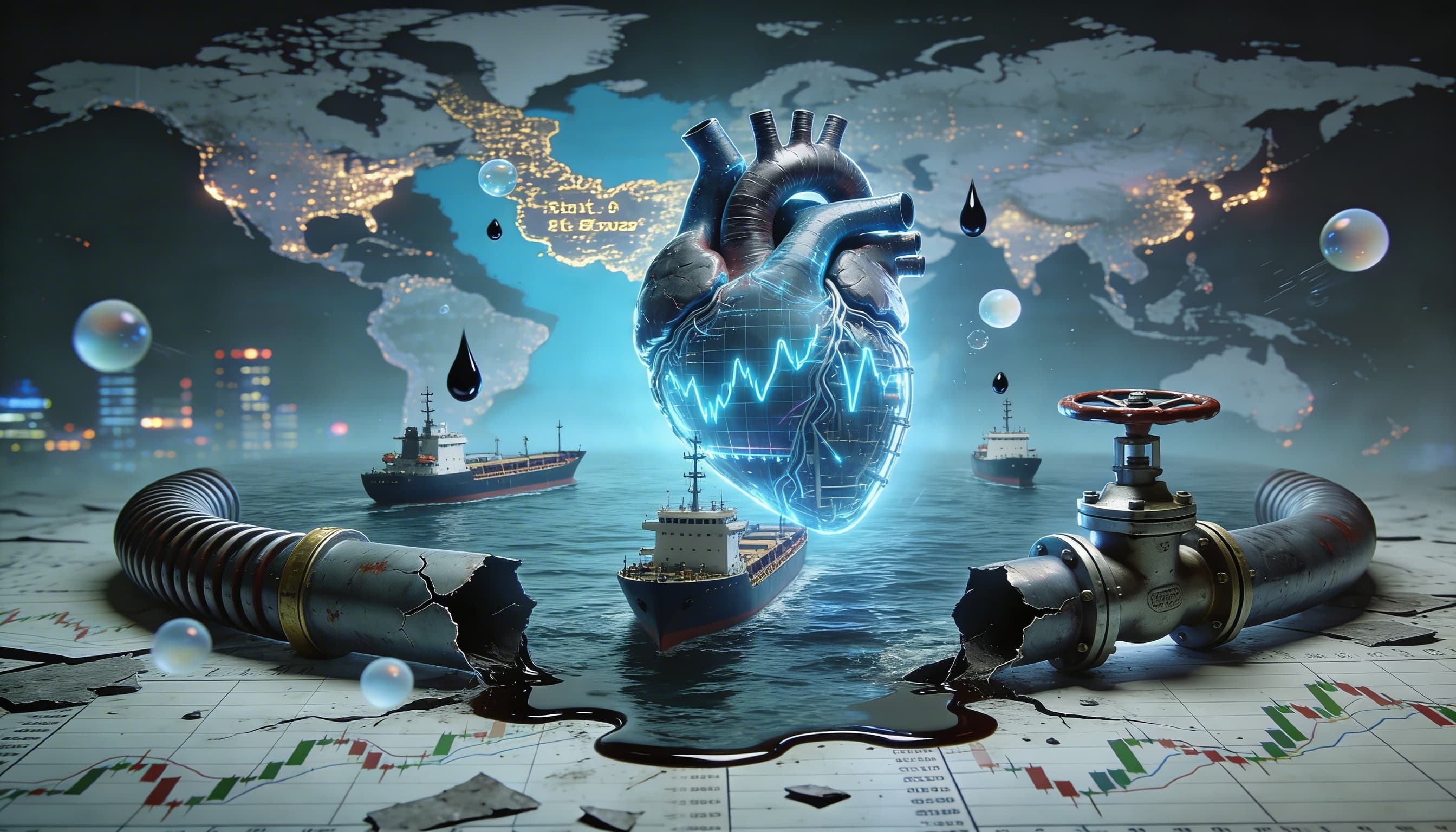
The chokehold on the world

For decades, the Strait of Hormuz has existed in the global consciousness as a geopolitical abstraction — a narrow, jagged ribbon of blue on a map that experts warned was the "jugular vein" of the modern world.
But as the closure of the Strait enters its second month, that abstraction has curdled into a cold, suffocating reality.
The world is no longer merely watching a regional skirmish; it is witnessing the slow-motion cardiac arrest of the global economy.
The physics of the crisis are as simple as they are devastating.
Through that thirty-mile-wide passage flows roughly one-fifth of the world’s petroleum and a similar share of its liquefied natural gas.
To seal the Strait for months is to effectively amputate a limb of the global energy system.
The question now haunting capitals from Washington to Beijing is no longer if a recession is coming, but whether the very architecture of global trade can survive the pressure.
A world without slack
In the immediate term, the impact has been felt at the pump and in the heating bill.
Brent crude has surged past $120 a barrel, a price point that acts as a regressive tax on every citizen on earth.
But the deeper danger lies in the "just-in-time" nature of our energy dependency.
Unlike oil, which can be partially diverted through a handful of overland pipelines across the Arabian Peninsula, the world’s supply of Liquefied Natural Gas (LNG) is captive to the sea.
Qatar, the world’s preeminent exporter, has no "Plan B."
For a Europe still weaning itself off Russian energy, the loss of Qatari gas is not just an inconvenience; it is an existential threat to its industrial base.
We are seeing the specter of "deindustrialization by force," as chemical plants and steel mills across the Rhine are forced to go dark, unable to compete with skyrocketing energy inputs.
The end of the "Great Easing"
The timing of the blockade has proven particularly cruel for central bankers.
For the better part of two years, the Federal Reserve and its peers have been engaged in a delicate dance, trying to coax inflation back to earth without crushing growth.
The Hormuz closure has effectively ended that dance.
By injecting a massive, non-negotiable cost into the global supply chain, the crisis has created a "stagflationary" trap.
Central banks cannot lower rates to stimulate a faltering economy because energy-driven inflation is rampant; yet they cannot aggressively raise rates without shattering a public already struggling with the rising cost of bread and transport.
The "soft landing" so many hoped for in 2026 has been replaced by a hard, jagged reality.
A geopolitical pivot
History may look back on this months-long closure as the moment the "Pacific Century" truly began, though perhaps not in the way theorists intended.
The nations of East Asia — China, Japan, and India — are the most acutely exposed to the Hormuz transit.
Their vulnerability has sparked a frantic, almost desperate acceleration toward energy sovereignty.
If the Strait remains closed, the reliance on the U.S. dollar as the primary medium for energy trade may face its greatest challenge.
Nations are already exploring "dark" markets and bilateral swap agreements to bypass a global financial system that suddenly feels too fragile to trust.
The blockade is not just stopping ships; it is eroding the trust that underpins the Western-led financial order.
The fragility of the ledger
There is a profound irony in the fact that in an era of satellite internet, artificial intelligence, and digital currencies, the world’s prosperity still hinges on the safe passage of tankers through a single, ancient waterway.
If the noose around Hormuz is not loosened soon, the "Great Recalibration" of 2026 will be remembered as the year the world learned that geography still matters more than technology.
We have spent half a century building a global economy that assumes the oceans are always open.
We are now discovering, at a staggering cost, what happens when that assumption is proven wrong.