

Fuel costs drive surge in Australian household spending

Australian household spending went up by 1.6% in March, marking an acceleration from the modest gains seen at the start of the year.
Data released by the Australian Bureau of Statistics reveals that while February and January saw incremental rises of 0.3% and 0.2% respectively, the national economy is now grappling with a 6.3% annual increase in nominal spending compared to March 2025.
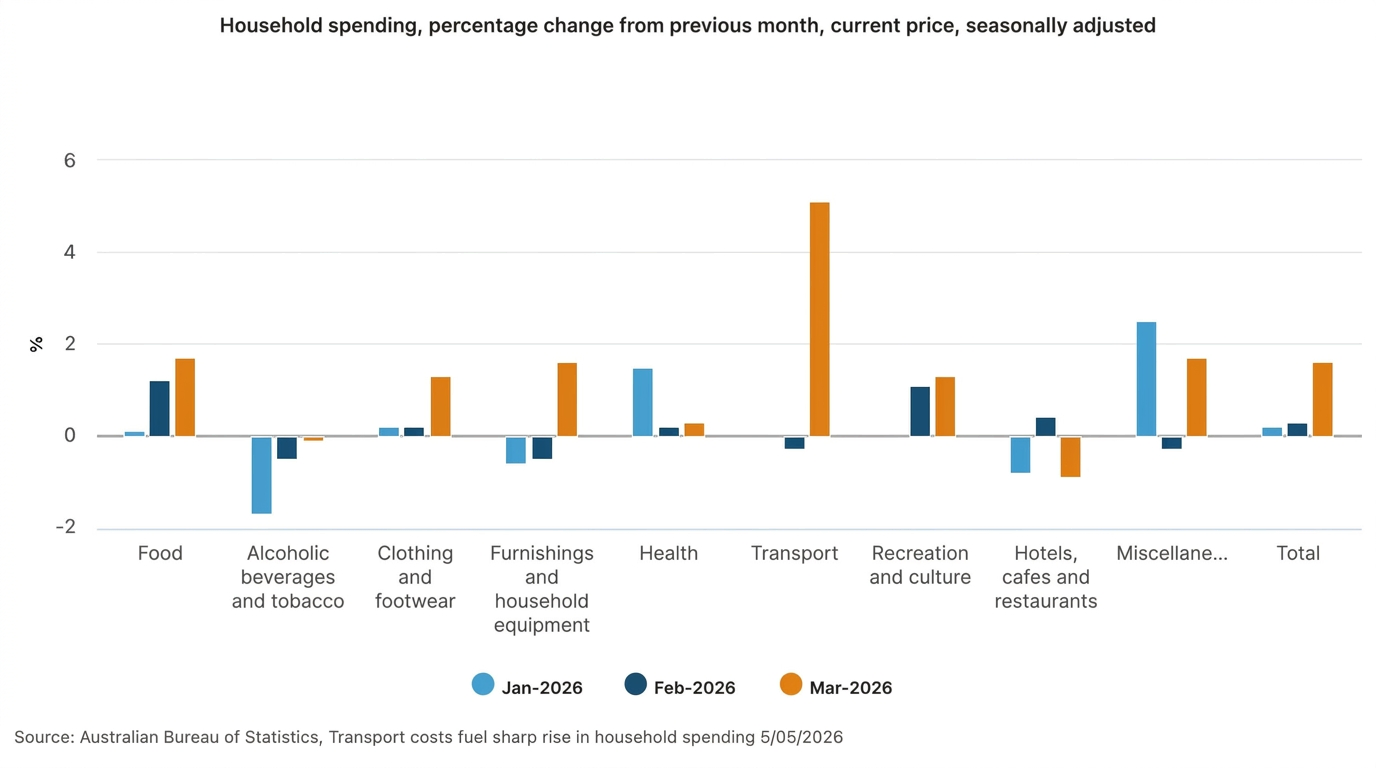
The primary catalyst for this spike was a 5.1% jump in transport costs, triggered by soaring fuel prices linked to ongoing conflicts in the Middle East.
According to Tom Lay, ABS head of business statistics, petrol prices peaked in late March, prompting motorists to alter their habits through smaller, more frequent trips.
The data suggests a shift in consumer behaviour; while public transport usage rose, experimental ABS estimates indicate that actual fuel volumes purchased dropped by 1.3% as households baulked at a staggering 32.8% monthly price hike.
Beyond the bowser, food spending rose by 1.7%, driven by price inflation and precautionary stockpiling amidst global supply chain concerns.
Despite these pressures, the March quarter saw a 0.7% rise in overall spending volumes—the sixth consecutive quarterly increase.
Growth was anchored by "non-discretionary" essentials, with health and food volumes rising 1.5% and 0.8%, respectively.
The resilience marks the strongest annual volume growth since mid-2023, even as cost-of-living pressures tighten their grip on the family budget.