

Aussie capital city growth slows as migration eases

Australia's metropolitan expansion has hit a speed bump, with new data from the Australian Bureau of Statistics revealing a sharp deceleration in capital city growth.
Despite adding nearly 325,000 residents during the 2024–25 financial year, the pace of urbanisation has cooled considerably compared to the record-breaking surges of the previous 12 months.
According to figures, the combined population of Australia’s capital cities grew by 1.8%, a dip from the 2.3% increase recorded in 2023–24.
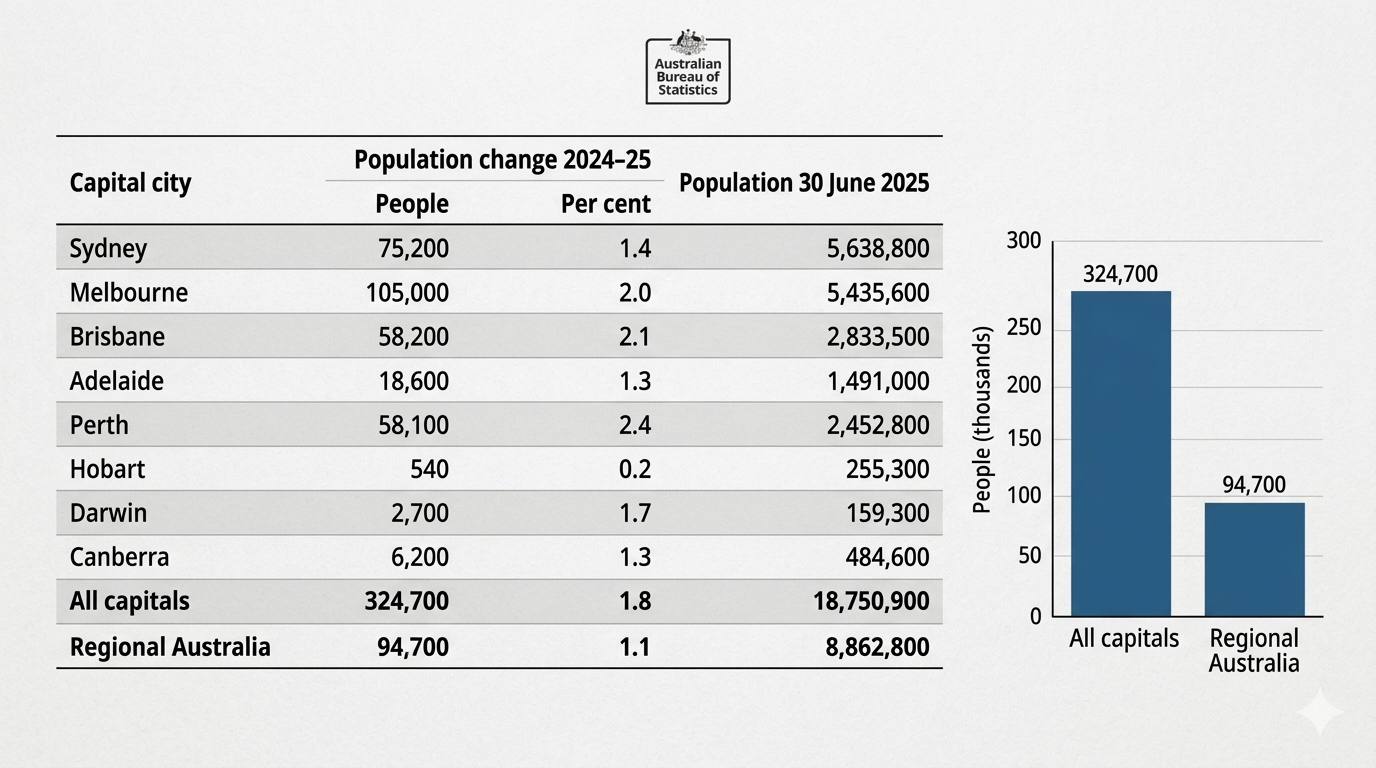
Phil Browning, the ABS head of demography, noted that while the cities added 324,700 people, this figure represents a shortfall of nearly 100,000 residents compared to the prior year's intake.
The slowdown is largely attributed to a cooling in net overseas migration, which, despite remaining the primary engine of growth, fell by 109,400 people year-on-year.
Western Australia continues to lead the nation’s charts, with Perth recording the highest growth rate at 2.4%, followed by Brisbane at 2.1% and Melbourne at 2%.
Conversely, Darwin emerged as the only capital to buck the national trend, accelerating its growth to 1.7%.
Browning highlighted that the most robust gains were concentrated in outer-suburban "fringe" areas, fuelled by internal migration.